

This is the Home Theatre I build in 2003. The project took me a good 200 hours of work excluding all the time spent beforehand doing all the planning. Below you will find a description of what I did. If you have any questions or comments, you are welcome to contact me on my commercial photography page.
Ray tracer
The first and
second pictures were generated using the Povray
ray tracer. I created them before starting construction because I
wanted to get some idea of what the room was going to look like,
especially with black walls! But this was not the only colour scheme
I tried. Many others were thrown out based on what they looked like
in the ray traced pictures. It took a lot of time learning to use the
ray tracer but it is something I will certainly use again to
visualize crazy decorating ideas.
Acoustics
The room was designed to have a relatively
flat frequency response with no curtains and carpets that will absorb
the high frequencies more than the low frequencies. Instead, the
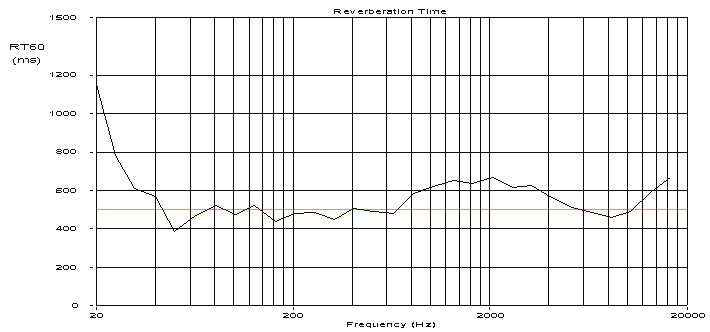
reverberation time was brought down to a theoretical 0.5 seconds by
adding 6.7m2 of wide band absorption. This was achieved by
building sound absorbers - four 1.2x1.4m boxes containing 200mm thick
low density fiberglass. Two of the four absorbers were placed at the
back of the room and the other two on the sides. (The one absorber is
visible in the last photo on the left side
of the room.) This placement has the added benefit of absorbing early
reflections creating a theoretical initial time gap of about 15ms.
The sound absorbers were made from 16mm MDF board and spray painted
using Plascon Velvaglo E30-7.
They were filled with two layers of 100mm thick Owens
Corning Aerolite 10kg/m3 fiberglass and covered with
speaker cloth. A reverberation time test is shown below:
Platform
The platform was made from 16mm chipboard. To
be on the safe side I used two layers of that on all the horizontal
surfaces. I also filled the cavities with fiberglass to avoid it
sounding hollow when you walk on it. I found that there are only two
ways to avoid squeaking: You have to make sure that there is a gap between
sections or that the sections are very well tied together. To get rid
of a squeak I had to disassemble part of the platform because the large
horizontal section was touching the back wall, but was not tied to it.
By leaving a small 5mm gap the problem was solved.
Walls
I experimented with three different types of black
paint: low gloss, matt and ultra-matt. In the end I liked the
ultra-matt Plascon Cashmere
E30-7 most. It took four coats of paint to get a good solid black
finish. If you are thinking of painting a room black, make sure that
this is the last thing you do. After painting the room black, it will
be too dark to do any other work in. (Don't ask how I know.)
Floor
The floor is Poliface
Home M611 - Cherry. I tested laminated floors made by four different
manufacturers by dropping a sharp object onto the samples. There were
no noticeable difference between them - all very easy to get
damaged. Initially I was disappointed with the Poliface
product. The colour was not consistent and there were many defects -
mostly small chips around the edges of the boards. With a lot of
juggling I managed to complete the floor without using defective
boards. And luckily for me the colour inconsistency is only visible
under high colour temperature lighting, like sunlight and flashlight.
Under low colour temperature tungsten lighting the problems disappear
and it looks really good.
Recommended reading
The Master Handbook of Acoustics -
F. Alton Everest
Sound Studio Construction on a Budget - F.
Alton Everest
www.erasmus.co.za
Copyright © 2001-2010 by Barnett Erasmus.
All rights reserved.